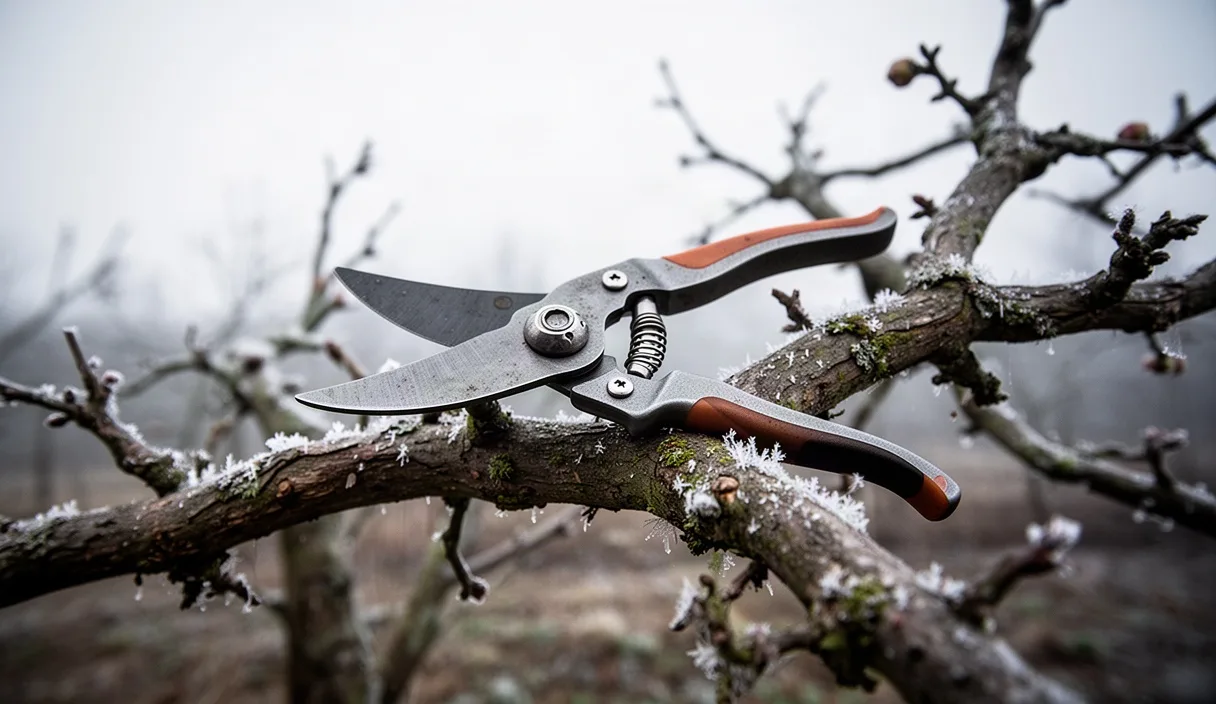
By late January across our valley, the ground carries a persistent chill, and the clay tracks between the rows of Bramley and Discovery turn slick with frost. A dormant apple tree shows its true architecture only when the leaves have spent two months rotting into the turf. Taking steel to an established canopy feels severe in the dead of winter, yet this annual thinning directs the sap where you want it to travel once the soil temperature creeps past five degrees Celsius in the spring.
Winter pruning governs vegetative vigour, sun penetration, and fruit distribution across branches that may have borne crops for thirty or forty seasons. An undisciplined tree slowly chokes its own interior, casting heavy shade that kills off the lower fruiting wood and breeds fungal spores in the damp, stagnant air. With a sharp saw, clean loppers, and an eye for the framework of the scaffold limbs, you can steady an old tree into a reliable habit of fruiting without sending it into an erratic cycle of biennial bearing.
Selecting the correct winter week before bud swell begins
Timing the work requires watching the weather vane and the tips of the shoots rather than sticking blindly to a calendar date. The window opens once the tree is in deep dormancy, usually by mid-December, and remains viable until the buds begin to show silken green or silver tips in late winter. In cold, low-lying parish bottoms where frost sits heavy in hollows, pruning too early in November leaves open wounds exposed to sub-zero spells that desiccate the surrounding cambium. Waiting until late January or February gives the tree the shortest possible gap between the cut and the surge of spring support tissue.
Choose a dry, calm morning when the daytime temperature rests above freezing. Pruning timber that is frozen solid causes brittle fractures along the bark ridges, resulting in jagged tears instead of clean shears. Furthermore, airborne spores of apple canker (Neonectria ditissima) travel on driving rain and splash freely across fresh wood exposed during wet snaps. If rain is forecast within forty-eight hours, leave the tools on the workshop bench and wait for a clear, brisk spell under a pale sky.
Keep a close watch on bud development as the days lengthen past Candlemas. Once the outer bud scales loosen and expose soft internal tissue, the sap is rising under pressure, and heavy dormant pruning at that stage will trigger excessive bleeding and sap loss. The ideal week arrives when the wood remains asleep, the buds are tight, and the long-range forecast promises three successive dry days with light breezes.
Sterilizing bypass loppers and folding saws between cuts
Canker and silver leaf fungus spread through human oversight as readily as through the wind. A blade that slices through an undetected fungal lesion on an old south-facing bough can inoculate the next ten healthy limbs within half an hour. Keeping cutting edges clean is not an occasional chore for the end of the day; it belongs directly in the rhythm of your work around the crown.
Bypass loppers handle lateral wood up to thirty millimetres thick, while a curved, Japanese-style folding saw with tri-edge teeth is necessary for mature branches. Anvil loppers should stay in the tool shed, as their crushing action bruises the delicate vascular cambium on both sides of the wood. Carry a spray bottle or a sealable metal tin filled with either a seventy-percent solution of isopropyl alcohol or methylated spirits. Commercial household disinfectant diluted to one part disinfectant to nine parts water also works well, though it requires a longer contact time of roughly sixty seconds to neutralise pathogens.
| Sterilising Agent |
Contact Time |
Corrosion Risk to Carbon Steel |
Practical Application Method |
| Isopropyl alcohol (70%) |
30 seconds |
Low |
Trigger spray bottle with clean rag wipe |
| Methylated spirits |
30 seconds |
Low |
Small dipping jar or saturated sponge |
| Bleach solution (10%) |
120 seconds |
High |
Dipping bath, requires oiling tools afterwards |
Spray or wipe the metal surfaces after removing any diseased, dead, or cankered timber before you lay the blade against sound wood. Wipe away residual sap with coarse wire wool or a scrap of burlap, apply the alcohol, and let the volatile liquid evaporate for half a minute. At the same time, keep a pocket oiler loaded with camellia oil or light machine oil to prevent carbon steel blades from pitting in the damp winter mist.
Removing water sprouts and competing vertical uprights
Established trees react to previous hard cutting by throwing up dense forests of vertical shoots known as water sprouts. These straight, whip-like growths shoot straight up toward the light from the upper bends of horizontal limbs. They produce almost no fruiting spurs in their early years, rob the lower canopy of sunlight, and act as chimneys that pull energy away from the spreading lateral branches where dessert and cooking apples naturally develop.
Tackle these upright growths systematically by following these practical pruning priorities:
- Cut out pure vertical shoots completely: Trace vigorous sprouts back to their origin on the top curve of the bough. Cut them flush to the bark ridge without leaving pegs, which will simply sprout three new whips from dormant eyes the following June.
- Retain strategically placed horizontal shoots: Where an open gap exists in the middle canopy, select one moderate shoot pointing outward at roughly forty-five degrees and leave it unpruned to develop future fruiting spurs.
- Thin out double leaders: Where two thick shoots run parallel and compete for the apex of a scaffold bough, remove the steeper, more inward-facing one to allow the lower limb to gather lateral light.
- Eliminate crossing and inward wood: Remove any shoot that turns back toward the centre of the trunk or rubs against an adjacent structural limb, as constant friction strips bark and invites infection.
Aim to remove no more than one-quarter of the total canopy volume in any single dormant season. Stripping every single water sprout out of a severely overgrown tree shocks the root system, triggering an even denser eruption of vegetative whips the following May. If an old tree resembles an unruly brush, distribute the corrective thinning across three successive winters to maintain balanced sap pressure.
Making clean collar cuts without tearing the outer bark
The branch bark ridge and the branch collar contain specialised cells that produce antibacterial chemical barriers and callus tissue over the wound. The collar is the distinct swelling or wrinkled shoulder where the branch emerges from the parent trunk or larger scaffold bough. Cutting into this collar damages the trunk itself, while leaving a long branch stub leaves dead wood that rot fungi use as a pathway into the heartwood.
Large branches carry significant weight, and letting a heavy limb drop under its own mass will peel a long strip of living bark down the trunk, creating a disfiguring wound that may never heal. For any limb thicker than forty millimetres, execute the three-cut method to relieve the mechanical load safely.
- Make the undercut: Position your folding saw on the underside of the limb roughly three hundred millimetres away from the branch collar. Saw upward through the wood until you penetrate roughly one-third of the branch diameter. If the saw begins to bind, stop immediately.
- Make the relief cut: Move the saw fifty millimetres further out along the limb, away from the trunk. Saw downward from the top surface until the wood gives way. The branch will snap cleanly between the two cuts without stripping bark down the primary stem.
- Make the final collar cut: You are left with an easily supported short stub. Locate the angled branch bark ridge on the upper side and the swollen collar below. Place your saw blade just outside these natural markers and cut downward at a slight outward angle, leaving the collar intact and the cut surface smooth.
Do not coat the finished surface with pruning paints, petroleum sealants, or wound dressings. Research across commercial and heritage orchards confirms that artificial dressings trap internal moisture and wood-decay fungi against the exposed xylem. An unsealed, cleanly angled cut dries out rapidly in the winter air, allowing the tree to compartmentalise the damage through its own natural suberin and lignin production.
Balancing current fruiting spurs against new replacement shoots
An established apple tree fruits primarily on compact, gnarly wood clusters known as spurs, which remain productive for six to ten years before their vitality begins to wane. On traditional spur-bearing varieties like Bramley, Egremont Russet, or Ribston Pippin, mature branches become overcrowded with sprawling spur systems that resemble knobby coral. Left unchecked, these systems set heavy clusters of undersized apples that the tree struggles to ripen, often leading to alternate-year cropping.
Tip-bearing varieties, including Worcester Pearmain and Discovery, behave differently by carrying a substantial portion of their crop on the terminal buds of slender shoots formed during the previous summer. Pruning every young shoot back to a spur on a tip-bearer will inadvertently remove the bulk of that year's crop. Before making systematic cuts, examine the tree to determine whether fruit buds are clustered tightly on aged dwarf spurs or carried predominantly on the tips of two-year-old lateral wood.
| Bearing Habit |
Typical Varieties |
Primary Fruit Location |
Pruning Approach |
| Spur-bearing |
Bramley, Cox's Orange Pippin, James Grieve |
Compressed, wrinkly side clusters on two-year and older wood |
Thin overcrowded spur systems, thin old spurs by a third to encourage strong single buds |
| Tip-bearing |
Discovery, Worcester Pearmain, Irish Peach |
Terminal buds of lateral branches produced the prior year |
Leave younger laterals under twenty-five centimetres uncut, thin shoots from base only |
| Partial tip-bearing |
Spartan, Charles Ross, Lord Lambourne |
Both terminal tips and short spurs along the branch length |
Moderate spur reduction combined with selective thinning of crowded side shoots |
On spur-bearing wood, thin out congested clusters where three or four spur structures crowd together within a handspan. Cut the weakest, downward-pointing clusters back to the parent wood with hand secateurs, leaving the upright and outward-facing spurs clear access to light. Aim to balance older spur wood with a steady supply of new maiden shoots, ensuring the tree continuously renews its bearing surfaces rather than relying on tired, brittle timber.
Common mistakes
The most frequent error in community orchards and domestic gardens is flat-topping or shear-pruning the outer canopy. Trimming the perimeter of an apple tree with hedge shears or shortening every outward shoot creates a dense, impenetrable broom of thin shoots the following summer, completely shading out the interior spurs. Pruning cuts should always be selective, targeting individual branch junctions rather than clipping an outline.
Another widespread mistake is over-pruning neglected trees in a single desperate afternoon. Removing more than thirty percent of an old tree's live crown triggers an aggressive hormonal reaction, dumping stored root carbohydrates into thousands of vertical water sprouts while starving the root system of leaf-produced sugars later in the season. Patience yields far better fruit: space restorative crown reductions across three winters, gradually bringing height down while keeping the balance of fruiting wood intact.
Finally, gardeners frequently neglect lower limb angles. Branches that form narrow V-shaped crotches with the trunk possess weak, included bark that splits easily under a heavy autumn crop. Where young structural boughs are competing, retain limbs that emerge at wide, strong angles between forty-five and sixty degrees from the vertical stem. If a large, mature limb shows signs of deep splitting, extensive internal hollows, or fungal brackets, consult a certified arborist to evaluate structural stability rather than attempting heavy takedowns with handheld equipment.
Putting the pruning rules to work
Gather your equipment on the next still, overcast morning. Sharpen the bypass loppers with a fine-grit diamond stone until the cutting edge slices through wet cardboard without catching, and inspect the folding saw to ensure no teeth are bent or gummed with dried sap. Fill a pocket bottle with surgical spirit and keep an oily rag in your coat pocket.
Stand back twenty paces from the tree before picking up a tool. Walk completely around the canopy, assessing where the interior is congested and identifying any branches that look dark, shrivelled, or blistered with canker lesions. Begin by taking out the dead, damaged, and diseased wood first. Step back again to judge the canopy light, then clear the pure vertical uprights, and finish by thinning out the oldest, tired spur clusters. Rake up the fallen trimmings, burn or bin any cankered timber away from the garden, and leave the clean orchard floor open to the late winter weather while the tree waits for spring.
This publication provides general horticultural guidance only: consult your municipal extension office or a certified arborist for persistent orchard blights and soil contamination concerns. Disclaimer