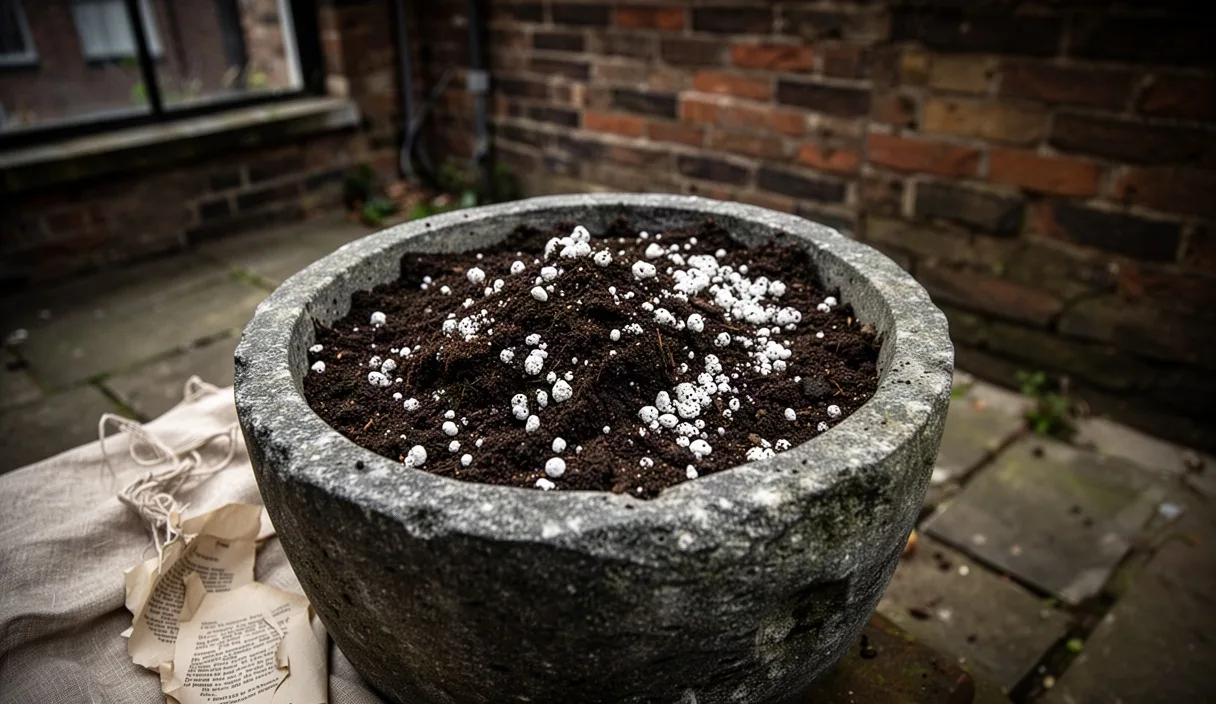
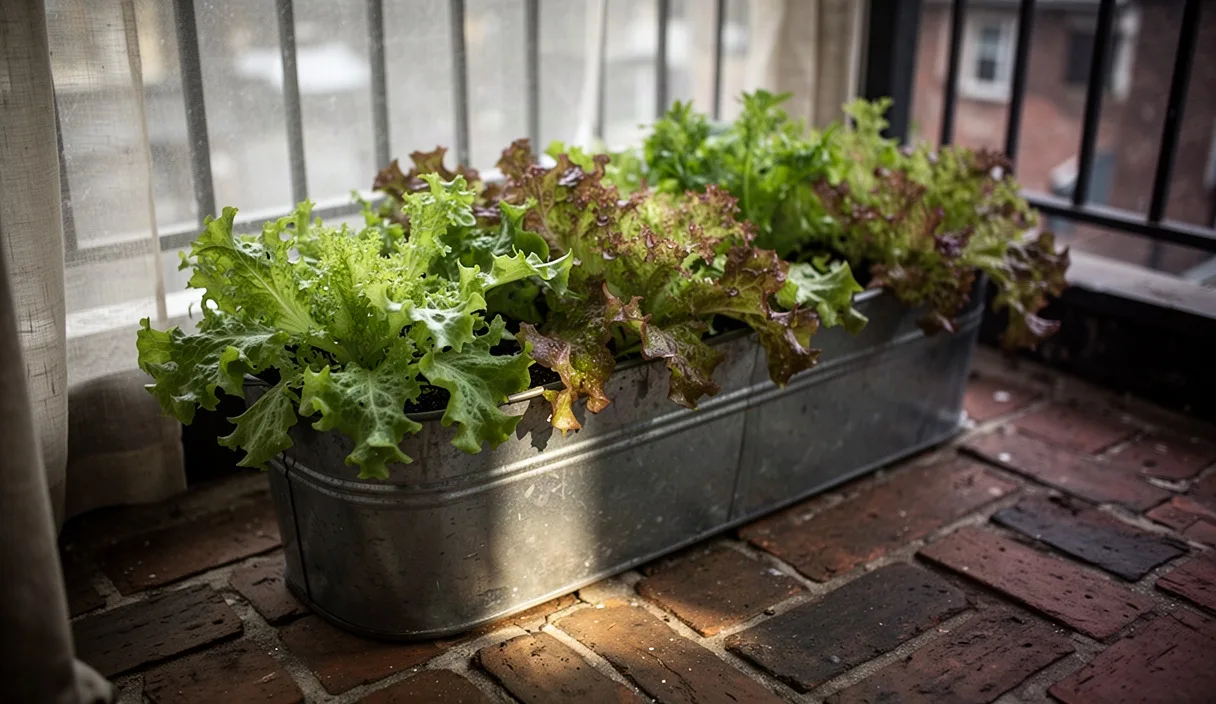
Casting your eye down a row of Victorian tenement blocks or modern dockside flats, concrete planters stand out as permanent fixtures. These vessels possess thick walls that buffer root zones against the sudden frosts of late autumn and the scorching afternoon sun reflected off brickwork. They are durable, heavy enough not to budge during November gales, and offer generous root room for deep-rooted crops like winter greens, dwarf beans, and bush tomatoes. Yet their sheer mass and cold porosity introduce hidden drainage problems that garden soil simply cannot handle within four solid walls.
Too many city growers tip wheelbarrows of garden topsoil or cheap, unamended peat into these broad concrete troughs, only to wonder why their summer courgettes collapse with root rot by mid-July. Concrete absorbs moisture until it reaches saturation, alters localized soil temperatures, and holds a heavy reservoir at its base if internal drainage falters. To keep balcony edibles thriving on upper floors without overstressing reinforced concrete slabs, the potting medium must be engineered for physics, aeration, and calculated bulk density.
The physics of perched water tables in outdoor planters
Every container filled with porous medium creates what soil scientists call a perched water table. In an open garden bed, gravity pulls excess moisture down through continuous subsoil layers until it meets the true water table deep underground. In a flat-bottomed container, that downward hydraulic pull stops dead at the drainage holes. The capillary forces of the potting mix, which pull water upwards and sideways through tiny pore spaces, become stronger than the gravitational pull trying to force water through the opening. As a result, a layer of saturated, airless mud sits permanently along the bottom few inches of the trough.
A widespread urban gardening habit involves tossing broken terracotta crocks or a two-inch layer of pea gravel into the bottom of a concrete trough, believing this improves drainage. Hydrology proves the opposite. Water does not readily move from the fine pores of a soil mix into the much wider voids of coarse gravel until the soil directly above is completely waterlogged. Placing gravel in the base simply raises the perched water table higher up the wall of the planter, pushing the oxygen-starved zone straight into the lower feeding roots of your plants.
The height of this perched water table depends entirely on particle size, not container depth. Fine particles create microscopic pores with tremendous capillary draw, keeping four to six inches of the base drenched. Coarser mixes built with chunky aggregates pull water upward with far less force, reducing the soggy zone to less than an inch. In low-slung, wide concrete tubs, where the total depth might only measure ten to twelve inches, a four-inch water table destroys roughly 38 percent of your usable root volume.
Why standard garden clay compacts into concrete in pots
Digging a spade into a productive allotment or community garden plot yields crumbly, dark earth rich in microbial glues and earthworm channels. Transfer that same loamy clay into an isolated concrete box on a fourth-floor balcony, and the dynamic collapses within six weeks. Without continuous burrowing by macro-organisms and the lateral movement of ground hydrology, sub-micron clay plates drift together. Every downpour causes these microscopic particles to settle flat, interlocking into an impermeable, cement-like block.
Municipal tap water and rooftop exposure accelerate this decline. Balcony containers dry out quickly under relentless cross-breezes, causing clay minerals to shrink and form deep structural fissures. When you water the planter with a hose or can, the water rushes straight down those perimeter gaps and out the drainage holes without wetting the root ball. The center remains bone dry, while the base turns into an anaerobic sludge. The table below illustrates how different soil textures behave once isolated inside container walls.
| Soil Component |
Pore Space Type |
Drainage Speed |
Compaction Tendency |
| Standard Topsoil Clay |
Micropores (less than 0.03 mm) |
Very slow (under 5 mm per hour) |
Severe; hardens when dry, slumps when wet |
| Milled Sphagnum Peat |
Mixed micropores |
Moderate |
Moderate; prone to hydrophobicity when dry |
| Washed Coconut Coir |
Mesopores and macropores |
Brisk (over 25 mm per hour) |
Low; resists settling over multiple seasons |
| Horticultural Pumice (3-6 mm) |
Structural voids and macropores |
Immediate runoff |
None; locks open pathways for root oxygen |
Furthermore, concrete itself leaches calcium hydroxide into the soil boundary, particularly when the planter is under three years old. This alkaline leaching raises the pH along the inner tub walls from a neutral 6.5 up toward 8.0 or higher. When combined with dense clay that holds water against the concrete perimeter, this chemical shift locks up vital micronutrients like iron, manganese, and boron, causing yellowing leaves across heavy-feeding balcony crops like chard and brassicas.
Building a porous base with coir, compost, and grit
To establish long-term structural integrity that will not collapse under heavy rains, you must build an engineered medium using structural amendments. The foundation relies on a balanced ratio between moisture-holding fibrous bulk, biological fertility, and permanent air-filled porosity. A proven volumetric blend for edible crops in large concrete tubs consists of 42 percent buffered coconut coir, 28 percent well-matured compost or worm castings, and 30 percent coarse mineral grit.
Coconut coir outperforms milled peat in structural longevity. Peat breaks down into dust within eighteen months of balcony temperature swings, while the woody lignin structure of coir stays stable for three to four seasons. Soak compressed coir bricks in warm water, then fluff the fibers thoroughly by hand before measuring. Ensure the coir is labeled as washed and low-salt, as unwashed coconut husk carries coastal sodium residues that burn sensitive seedling roots.
For the mineral grit fraction, avoid builder's sand or fine silver sand, which fill air spaces and turn potting mixes into mortar. Instead, use a mix of coarse horticultural pumice, crushed volcanic scoria, or expanded clay pebbles screened to sizes between 3 mm and 7 mm. Coarse horticultural perlite can work, but its featherweight nature causes it to float to the surface during heavy watering, leaving the base dense. Horticultural pumice stays anchored throughout the profile, creating stable air channels that allow roots to breathe even immediately after a continuous three-day autumn rain.
- Hydrate your coir block in a wheelbarrow or wide flexi-tub using 4 liters of water per 1 kg block, working out the dense lumps until loose and airy.
- Screen your organic compost through a 10 mm mesh sieve to catch large woody debris that steals nitrogen during decomposition.
- Rinse the horticultural pumice or grit over a fine screen to wash away mineral dust that would otherwise settle into bottom pore spaces.
- Tumble the ingredients together on a clean ground tarp, mixing the components dry until the pale pumice is evenly dispersed throughout the dark organic fiber.
- Add base organic nutrients: mix in 60 grams of bone meal or rock phosphate, 40 grams of kelp meal, and 30 grams of agricultural gypsum per 40 liters of prepared mix to counter potential concrete alkalinity.
Calculating overall wet weight for apartment balcony safety
Balconies on modern apartment buildings are engineered around specific load allowances governed by regional building codes. Typical domestic cantilevered balconies or suspended terraces are rated for a variable live load between 1.5 kilonewtons per square meter (roughly 153 kilograms per square meter) and 2.5 kilonewtons per square meter (roughly 255 kilograms per square meter). A substantial concrete tub, when filled with drenched soil and mature plants, can easily threaten these thresholds if you do not calculate the wet weight beforehand.
Consider an unplanted concrete trough measuring 100 cm long, 40 cm wide, and 40 cm high. The empty dry concrete shell itself usually weighs between 45 and 65 kilograms. Its internal volume holds approximately 120 liters of growing medium. When completely saturated with water, standard topsoil weighs roughly 1.8 kilograms per liter, adding 216 kilograms of earth. Add the weight of mature summer crops, staking timber, and a human being standing next to the tub to tend it, and you exceed 340 kilograms resting on a footprint of just 0.4 square meters. That results in a localized loading of 850 kilograms per square meter, vastly exceeding typical residential safety thresholds.
By engineering your potting mix with coconut coir and horticultural pumice, you drastically cut the bulk density. Saturated coir weighs roughly 0.85 kilograms per liter, while horticultural pumice weighs approximately 0.65 kilograms per liter wet. The modified mix described in the previous section averages a wet density of approximately 0.95 kilograms per liter. Over the same 120-liter volume, the saturated soil weight drops from 216 kilograms down to roughly 114 kilograms. When planning high-density balcony layouts, always consult the original building schematics or hire a certified structural engineer to establish the safe live load of your specific slab, especially in older conversions where steel reinforcement bars may have suffered water ingress over decades.
Top dressing techniques to preserve water on windy upper floors
Wind velocity climbs steadily the higher you go above ground level. A fifth-floor balcony facing the street or river often experiences air speeds two to three times greater than a walled courtyard below. This continuous airflow strips moisture from the surface of concrete tubs via evaporative wick-action, causing the top three inches of soil to desicate within hours. Leaving bare soil exposed leads directly to surface crusting, broken fine feeder roots, and erratic moisture swings that trigger blossom end rot in tomatoes and premature bolting in brassicas.
Wood bark mulch, while standard in ground beds, is problematic in windy balcony setups. Dry wood chips weigh very little and blow around the balcony floor, clogging balcony drain pipes during heavy storms. A much more reliable choice is an inch-thick blanket of 6 mm to 10 mm river pea gravel, washed tumbled slate chips, or coarse crushed terra-cotta pellets. This mineral top dressing provides physical ballast against high gusts, prevents rain from displacing the engineered mix beneath, and stabilizes surface temperatures by shielding the soil surface from direct radiation.
For leafy edible crops and fast-growing salads, an organic alternative is thick raw wool fleece or felted sheep's wool pads cut to fit around the plant stems. Wool possesses remarkable insulating properties, repels slugs seeking moisture, breaks down slowly to release trace amounts of nitrogen, and lets rain pass through while suppressing upward moisture vaporization. Secure the edges of wool mats beneath a thin border of flat river stones to stop the blustering city wind from lifting the corners.
Common mistakes
- Neglecting drainage hole screens: Placing soil directly over concrete drainage holes causes fine coir to flush out, muddying the balcony and eventually plugging the drain opening entirely. Cover holes with flat fiberglass insect mesh, not solid stones.
- Reusing exhausted indoor houseplant mix: Old houseplant peat is typically loaded with concentrated fertilizer salts and spent dust particles that instantly consolidate into an airless silt layer in outdoor troughs.
- Positioning tubs flat against the deck: Sitting a concrete tub flat on balcony tiles traps water beneath the base, creating a seal over the drainage holes and rotting the balcony deck surface. Always set tubs up on half-inch clay or rubber pot feet.
- Using unrinsed builder's gravel for ballast: Adding sharp, unwashed ballast brings fine stone dust and free lime into the root zone, raising the substrate pH to unmanageable levels for edibles.
Practical next steps
Before buying bags of substrate, locate your planter's final position. Push your concrete tub tight against the structural wall of the building rather than against the outer railing; the cantilevered slab can carry significantly more dead weight closer to the load-bearing masonry. Slip rubber pot feet underneath each corner, ensuring the drainage openings sit clear of the floor by at least 15 millimeters.
Measure the interior length, width, and height of the planter in centimeters, multiply them together, and divide by 1,000 to find the total soil volume in liters. Order your buffered coconut coir bricks, sieved compost, and 3 mm to 6 mm horticultural pumice based on the 42-28-30 volumetric ratio. Keep a batch of fine mesh ready to cover the base holes, mix the components evenly on a clean sheet, fill the tub to within two inches of the top rim, and water the entire mix thoroughly twice before sowing seeds or setting in your vegetable starts.
This publication provides general horticultural guidance only: consult your municipal extension office or a certified arborist for persistent orchard blights and soil contamination concerns. Disclaimer